
In-depth Analysis of Thermodynamic Principles of Gas Stove Burner Heads: From Combustion Basics to Efficiency Optimization
Explore the thermodynamic principles of gas stove burner heads, including combustion processes, heat transfer, efficiency calculations, and other professional content, providing a theoretical basis for product design and optimization.
**Introduction**
Thermodynamic principles form the theoretical foundation for the design and optimization of gas stove burner heads. A deep understanding of these principles can help engineers develop more efficient and energy-saving products.
**Basic Combustion Theory**
- Combustion Chemical Reactions
– Complete combustion equations
– Theoretical air volume calculations
– Combustion product analysis
- Flame Characteristic Analysis
– Premixed combustion principles
– Diffusion combustion characteristics
– Flame stability theory
**Heat Transfer Mechanisms**
- Conductive Heat Transfer
– Material thermal conductivity coefficients
– Heat conduction calculations
– Heat conduction optimization design
- Convective Heat Transfer
– Natural convection analysis
– Forced convection optimization
– Flow field design improvements
- Radiative Heat Transfer
– Infrared radiation principles
– Radiation efficiency enhancement
– Impact of surface treatment
**Efficiency Analysis and Optimization**
- Thermal Efficiency Calculations
– Theoretical thermal efficiency
– Actual thermal efficiency measurement
– Efficiency loss analysis
- Optimization Techniques
– Air preheating technology
– Waste heat recovery utilization
– Insulation material applications
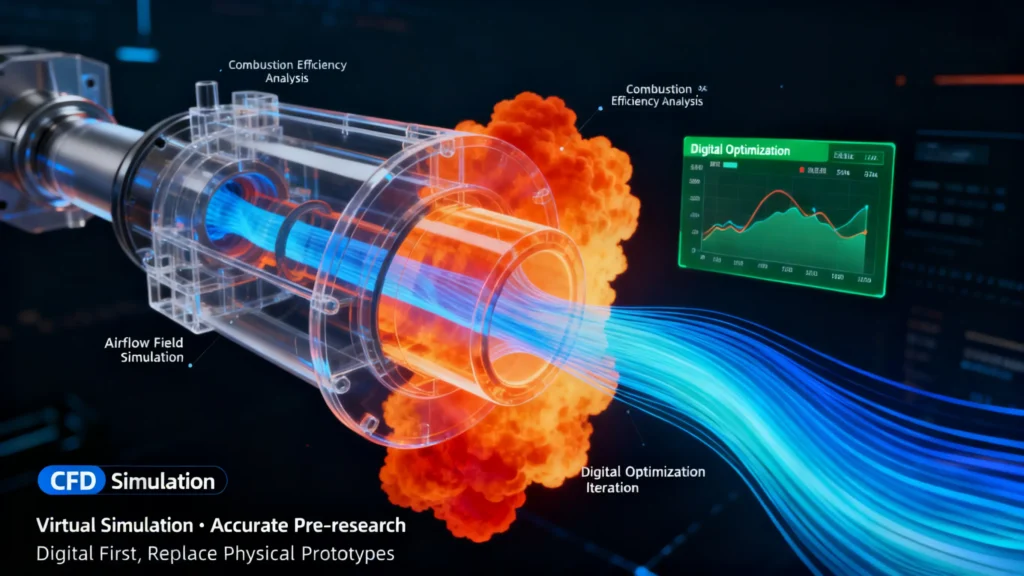
**Computational Fluid Dynamics Applications**
- CFD Simulation Analysis
– Flow field simulation
– Temperature field analysis
– Concentration field prediction
- Optimization Design Cases
– Nozzle structure optimization
– Mixing chamber improvements
– Flame distribution uniformity
**Experimental Verification Methods**
- Thermal Testing Platform
– Temperature measurement systems
– Flow metering devices
– Flue gas analysis instruments
- Data Analysis Methods
– Efficiency calculation models
– Uncertainty analysis
– Optimization effect verification