Common Quality Issues in Gas Stove Burner Parts and How Manufacturers Solve Them
Introduction
In gas stove production, burner parts quality plays a decisive role in safety, performance, and customer satisfaction. Even small defects in gas stove burner parts can lead to unstable flames, reduced efficiency, or premature failure—especially in commercial or high-usage environments.
This article outlines the most common quality issues in gas stove burner parts and explains how professional manufacturers identify, prevent, and solve these problems through material selection, process control, and engineering improvements.

1. Uneven Flame or Flame Lifting
The Issue
One of the most frequent quality complaints is uneven flame distribution or flame lifting during operation. This problem affects cooking performance and may cause safety concerns.
Common Causes
Inconsistent flame port size
Poor machining accuracy
Improper gas-air mixing design
Manufacturer Solutions
Precision drilling or punching of flame ports
Strict dimensional inspection of burner holes
Optimized venturi and air intake design
Reliable manufacturers use calibrated tooling and flame testing to ensure consistent combustion across all burner ports.
2. Burner Parts Warping or Deformation Under Heat
The Issue
Burner components may deform after prolonged exposure to high temperatures, leading to misalignment or flame instability.
Common Causes
Low-grade materials
Insufficient wall thickness
Inappropriate surface treatment
Manufacturer Solutions
Use of cast iron or heat-resistant steel for high-temperature zones
Structural reinforcement in burner design
Selection of coatings specifically designed for burner applications
Professional manufacturers test burner parts under continuous high-temperature conditions to verify structural stability.
3. Corrosion and Rust Formation
The Issue
Corrosion reduces burner lifespan and negatively affects appearance, especially in humid environments or commercial kitchens.
Common Causes
Inadequate surface protection
Improper storage or transportation
Low-quality coatings
Manufacturer Solutions
Application of high-temperature inorganic coatings
Use of stainless steel flame rings where required
Controlled packaging and moisture protection during shipping
Surface treatment selection is critical for long-term performance.
4. Ignition Failure or Delayed Ignition
The Issue
Ignition issues frustrate users and can pose safety risks if gas accumulates before ignition.
Common Causes
Poor alignment between ignition system and burner
Carbon buildup around ignition points
Inaccurate burner geometry
Manufacturer Solutions
Precise positioning of ignition contact areas
Improved burner surface design to reduce residue buildup
Compatibility testing with various ignition systems
OEM manufacturers often test ignition reliability across thousands of cycles.
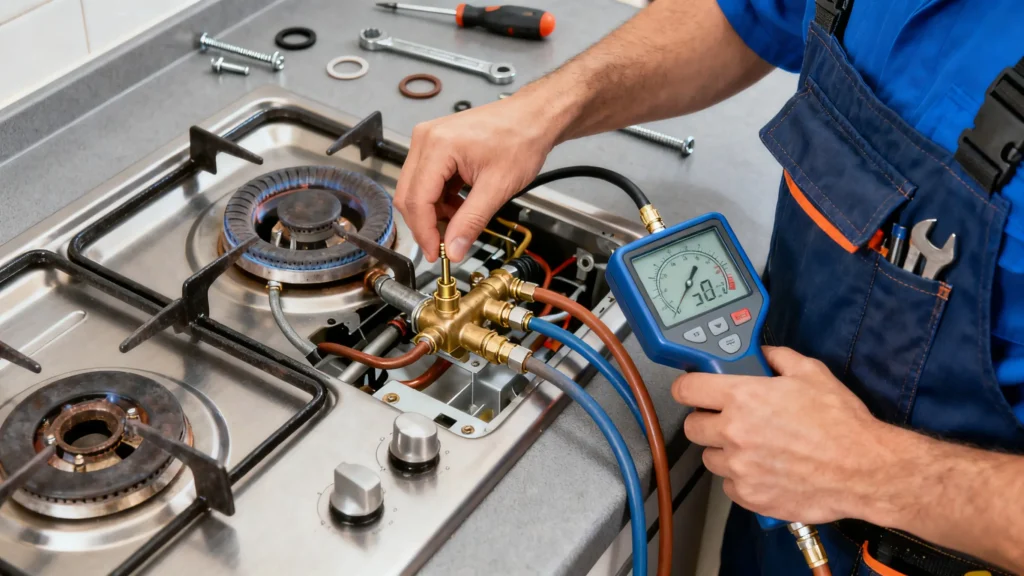
5. Gas Leakage at Burner Connections
The Issue
Gas leakage is a critical safety concern that can result in serious hazards.
Common Causes
Poor sealing surfaces
Dimensional inaccuracies
Incompatible burner and valve interfaces
Manufacturer Solutions
Tight tolerance control during machining
Leak testing at multiple production stages
Design optimization of burner-to-valve interfaces
Quality-focused manufacturers implement 100% leakage inspection for safety-critical components.
6. Inconsistent Product Quality Between Batches
The Issue
OEM stove manufacturers often face inconsistent burner quality from batch to batch, leading to assembly issues and higher rejection rates.
Common Causes
Unstable raw material supply
Lack of standardized production processes
Insufficient quality control systems
Manufacturer Solutions
Stable material sourcing and traceability
Standardized molds and tooling
Statistical process control (SPC) in mass production
Consistency is a key indicator of a reliable gas stove burner parts supplier.
7. Short Service Life in Commercial Applications
The Issue
Burner parts used in commercial stoves may fail earlier than expected due to continuous heavy usage.
Common Causes
Residential-grade materials used in commercial burners
Underestimated thermal load
Insufficient durability testing
Manufacturer Solutions
Design differentiation between household and commercial burner parts
Increased material thickness for high-load models
Long-duration endurance testing
Professional manufacturers clearly classify burner parts by application type.
How Manufacturers Prevent Quality Issues in Gas Stove Burner Parts
Experienced manufacturers focus on prevention rather than correction. Key practices include:
Material verification before production
Multi-stage inspection during casting or machining
Flame and gas flow testing
Continuous improvement based on field feedback
OEM-focused manufacturers also work closely with stove brands to refine designs and improve performance over time.
Conclusion
Understanding common quality issues in gas stove burner parts helps stove manufacturers make better sourcing and design decisions. By working with experienced manufacturers who prioritize material quality, precision manufacturing, and thorough testing, OEM stove producers can significantly reduce risks and improve product reliability.
High-quality burner parts are not just components—they are the foundation of safe, efficient, and durable gas stoves.